
How to Test a Business Idea Before Starting
Launching a business brings a lot of excitement, but even the best concept needs real-world validation to survive. Before you hand in your resignation, pour in your savings, or sink months into development, you need to know if there is an actual market for your offer. Figuring out how to test a business idea before starting lets you catch major red flags early on, helping you make smarter decisions every step of the way.
Below, you will find straightforward strategies to validate your concept, learn what your ideal audience actually wants, size up the competition, and figure out if your offer can turn a real profit.
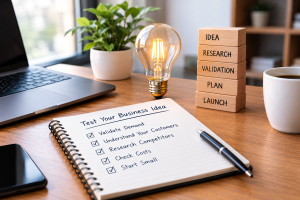
Why Should You Test a Business Idea Before Starting?
First-time founders often get so wrapped up in their product that they forget to check if anyone actually wants to buy it. Running a few simple tests beforehand gives you clarity before you make a heavy financial commitment.
Validating your concept early allows you to:
-
Pinpoint real customer pain points
-
Map out your ideal customer base
-
Spot current competitors in the space
-
Uncover hidden flaws in your initial plan
-
Gauge whether people are actually willing to open their wallets
-
Refine your offer before launching publicly
Validation will not make you bulletproof, but it strips away a massive chunk of unnecessary risk.
How to Test a Business Idea Before Starting :Steps
1. Clearly Define the Problem
Begin by looking at the specific pain point you intend to solve. A sustainable business fixes a genuine frustration rather than simply relying on something you personally find cool.
Be ready to answer these four questions:
-
What exact challenge is the customer facing?
-
Who suffers from this issue the most?
-
What workarounds or alternatives are they using right now?
-
Why would they switch to your approach?
If you struggle to articulate the problem clearly, take a step back and dig deeper into your initial research.
2. Identify Your Target Customers
Testing is useless if you are gathering feedback from the wrong group of people.
Build a quick profile of your ideal buyer by looking at:
-
Age demographics
-
Geographic location
-
Job title or industry
-
Hobbies and lifestyles
-
Spending habits and budget
-
Day-to-day pain points
-
Preferred purchasing habits
Instead of pitching to a broad phrase like “anyone interested in staying fit,” narrow your scope to “busy office workers looking for quick, budget-friendly online workouts.” The more specific your audience, the clearer and more useful your feedback will be.
How to Validate a Business Idea Before Starting?
When you are trying to figure out how to test a business idea before starting, nothing beats having real conversations with the people you plan to serve.
3. Talk to Potential Customers
Direct chats often reveal deep insights that you will never find through an online search.
When you sit down with target buyers, guide the conversation with questions like:
-
What is the hardest part about dealing with this issue?
-
How are you handling it right now?
-
What frustrates you about the tools or services you currently use?
-
Would you pay for something that solves this better?
-
Which specific features would make the biggest difference for you?
Try not to rely on simple questions like “Would you buy this?” Most people want to be polite, but a polite yes rarely turns into a paying customer. Instead, focus your questions on their actual habits and past struggles.
4. Research Your Competitors
Existing competitors are actually a great sign. If other companies are actively serving your market, it proves that people are already spending money on a solution.
Take time to look closely at:
-
What competitors are selling
-
Their pricing structure
-
What customers say in online reviews
-
How they promote their business
-
Frequent customer complaints
-
The specific features users love most
Keep an eye out for gaps in their offerings that you can fill. If customers constantly complain about confusing setups, unhelpful support, or hidden fees, you have a clear opportunity to build a better alternative.
5. Create a Simple MVP
A minimum viable product (MVP) is the stripped-down, bare-bones version of your offer that lets you gather real-world feedback without spending endless time or money building out every feature.
You can learn how to test a business idea before starting by using simple approaches like:
-
A single-page website with a clear offer
-
A working product prototype
-
A basic, introductory service tier
-
A short walk-through or video demo
-
A straightforward digital store
-
An initial one-on-one consulting session
-
A pre-order campaign
The goal here is simple: gather genuine reactions before committing heavy resources.
What to Check Before Starting a Business?
If you want to know what to check before starting a business, center your attention on market demand, target buyers, existing rivals, startup costs, and your practical capacity to deliver.
6. Check Whether People Will Pay
A compliment is nice, but a transaction is real proof. A person might praise your concept all day long and still hesitate when it comes time to pull out their card.
Put real demand to the test with a mini sales run. Try launching a small-scale service, taking early pre-orders, or selling a limited batch of your basic product. How people act with their wallet tells you far more than any casual feedback ever will.
7. Calculate Basic Costs
Run the numbers early on to map out both your initial launch expenses and recurring operating bills.
Factor in items such as:
-
Materials and gear
-
Domain, hosting, and design costs
-
Advertising and promo budgets
-
Shipping supplies
-
Essential apps and software platforms
-
Delivery and logistics
-
Contractor or team hiring fees
-
Regulatory setup and local licensing
Once you have a general tally, figure out the minimum sales volume required to break even. You do not need complex accounting at this phase; a quick, back-of-the-napkin calculation is enough to show if the math actually works in your favour.
8. Run a Small Market Test
Rather than launching on a grand scale right out of the gate, introduce your offer to a small, specific group first.
A practical rollout might look like this:
-
Focus on a narrowly defined segment of buyers.
-
Offer your simplified product or service.
-
Monitor incoming inquiries and actual sales.
-
Gather direct feedback from early users.
-
Refine your offer based on what you learn.
-
Run another small test to gauge the changes.
This approach lets you gather crucial data while keeping your financial exposure low.
Use Online Research to Test Your Idea
Digital platforms offer a treasure trove of insights into what people are actively searching for and talking about.
Useful places to dig for information include:
-
Google search trends and suggested terms
-
Community forums like Reddit and Quora
-
Discussions across social media channels
-
User reviews on third-party sites
-
Competitor websites and landing pages
-
Niche industry blogs and publications
Pay close attention to recurring complaints and questions. These frequently point directly to frustrations people want solved. Just keep in mind that online chatter does not automatically translate to sales, so pair your digital findings with direct customer interviews and hands-on testing.
Common Mistakes When Testing a Business Idea
Steer clear of these frequent pitfalls during the testing phase:
Testing Only With Friends and Family
While loved ones mean well, their encouragement is often biased and rarely reflects how real buyers will respond.
Spending Too Much Before Testing
Pouring huge sums into inventory, heavy equipment, elaborate branding, or massive ad campaigns before proving demand is a recipe for wasted capital.
Ignoring Negative Feedback
Critical notes are often the most helpful. They point out pricing mismatches, missing functionality, or weak messaging before it hurts your main launch.
Trying to Serve Everyone
Broad offers get lost in the noise. Narrowing your focus makes it significantly easier to connect with the right people and solve their specific problem.
When Should You Move Forward?
Once your initial testing wraps up, evaluate the data you have gathered.
Reflect on these key questions:
-
Is this problem genuine and widespread enough?
-
Are target buyers actively searching for a way to fix it?
-
Have people shown a clear willingness to pay for a solution?
-
Do you have the resources to deliver effectively?
-
Can the business generate sufficient revenue to stay profitable?
-
What tweaks do you need to make before launching full-scale?
You do not need a flawless score to take the next step. The goal of learning how to test a business idea before starting is simply to sharpen your direction and eliminate avoidable blunders. Before launching, you can also write a business plan to organize your goals, costs, target market, and business strategy
Final Thoughts
Mastering how to test a business idea before starting saves you time, energy, and money by taking the guesswork out of building a brand. Start by isolating a real frustration, studying your ideal audience, reviewing what competitors offer, building a simple MVP, and verifying that people will actually pay for it.
Above all, view your early tests as a learning loop. Let real user behaviour and honest feedback guide your adjustments before you launch a full-scale operation.
FAQs
1. How to validate a business idea before starting?
Connect directly with potential buyers, analize existing competitors, clearly define the problem you fix, build a basic offer, and run a small test to see if people will pay for it.
2. What to check before starting a business?
Evaluate market demand, existing rivals, pricing models, initial setup costs, running expenses, target customer profiles, and your actual capacity to deliver.
3. Is a business idea worth testing before investing money?
Absolutely. A low-cost test exposes hidden flaws and clarifies target customer needs long before you commit major funds.
4. What is an MVP in business?
An MVP (minimum viable product) is a basic version of your offer built to test market demand and gather real feedback with minimal effort and expense.
5. Can customer feedback change a business idea?
Yes. Real user input often uncovers unexpected needs, pricing issues, or missing features that can significantly improve your original plan.
Pingback: Service-Based Business Ideas for Beginners: 10 Best Options - My Blog